Built to turn everyday health data into questions worth studying.
MATILDA brings together longitudinal signals and personal context to explore how daily routines relate to health over time. Its research framework centers transparency, patient relevance and evidence that can be examined.
Longitudinal signalsPersonal contextChanging patternsQuestions for review
The signal matters. The circumstances around it matter too.
A glucose reading, meal, night of sleep or period of activity can be informative on its own. Studying how those events relate across time can provide a more useful view of everyday health.
Look beyond one moment.
Patterns become easier to examine when readings are viewed across days, weeks and changing routines.
Keep daily life in the record.
Meals, activity, sleep, medication, schedules and observations help frame what the numbers may mean.
Study change against the individual.
Patient-specific baselines provide a more relevant reference than treating every person as an average.
Context becomes more useful when it stays on the timeline.
This illustrative research view shows how separate signals and personal context can be aligned for pattern review without presenting a diagnosis or claiming causation.
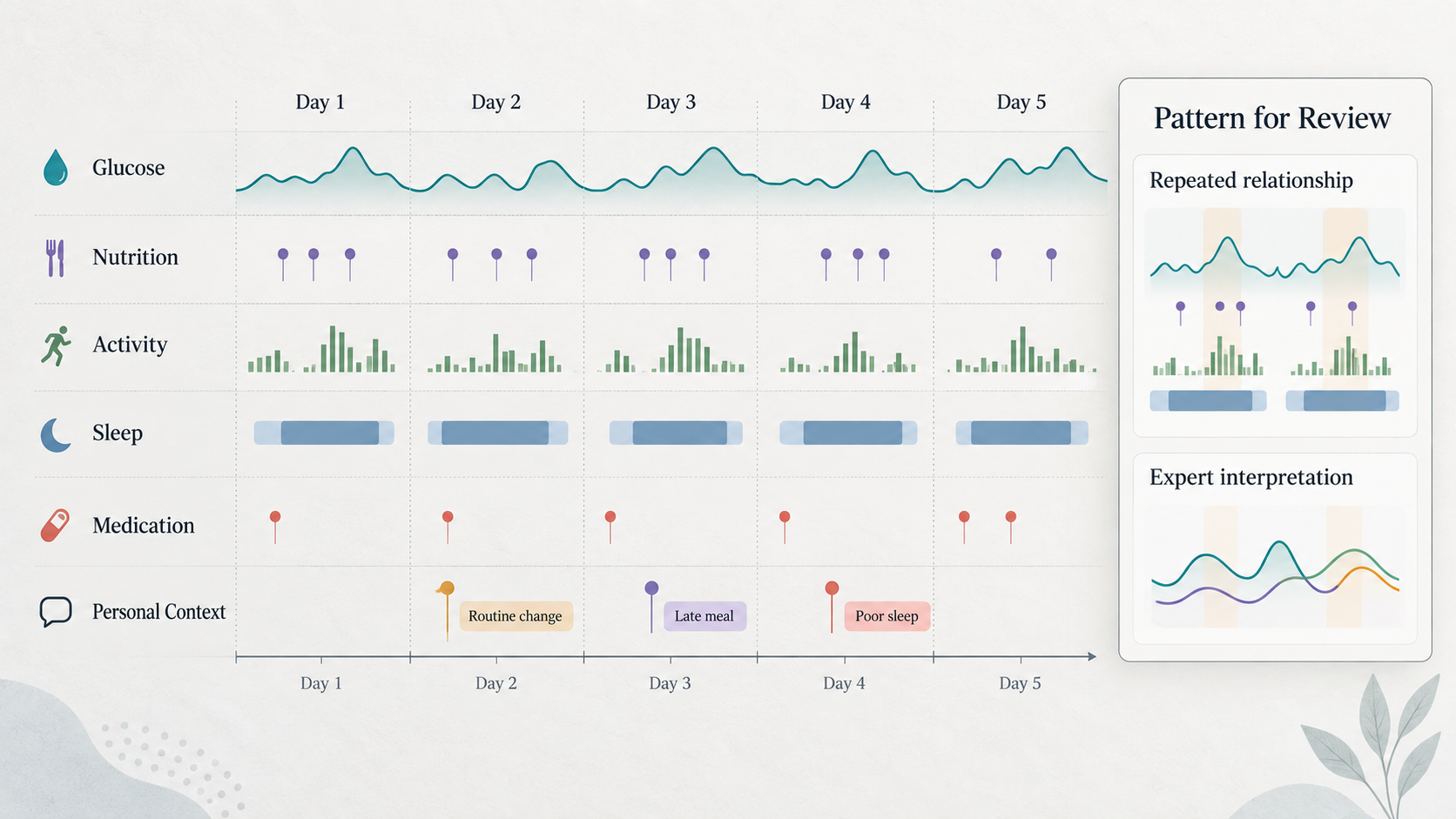
Keep signals on the same timeline, test recurring patterns and review interpretations.
A more complete history for research and care conversations—without treating a pattern as proof of causation.
A disciplined path from observation to evidence.
MATILDA’s research approach separates what the platform observes, what its model suggests and what can be supported through formal evaluation. That distinction helps keep product language aligned with the strength of the available evidence.
Research begins with the problems people actually face.
MATILDA’s connected model creates opportunities to study how context can improve understanding, engagement and the conversations surrounding care. Early product evaluation begins with lighter recommendations for action, allowing usefulness, traceability and user response to be studied before more consequential guidance is considered.
review
AccuracyRelevanceConsistencyFairnessClarity
Useful intelligence must be tested from more than one angle.
MATILDA’s in-house machine-learning model was designed to learn from each user’s authorized data and adapt its internal understanding over time. Evaluating that system requires more than measuring technical performance alone.
Research must also examine whether outputs are understandable, relevant to the individual, consistent over time and appropriate for the decisions they are meant to support.
Built for work that crosses disciplines.
Meaningful evaluation can involve patients, clinicians, behavioral scientists, data scientists, health-system partners and technology collaborators. Each perspective helps test a different part of the experience, including provider-portal usability and the responsible sharing of user-authorized data with trusted medical professionals.
MATILDA welcomes conversations with organizations interested in responsible digital-health research, pilot design and real-world evaluation.
The architecture creates questions worth evaluating.
MATILDA’s individualized models, cloud infrastructure and provider workflows create a research agenda that extends beyond predictive accuracy.
Evidence should strengthen understanding without overstating certainty.
Pattern exploration
Organizes connected information so relationships and changes can be reviewed more clearly.
Informed discussion
Helps people and authorized care teams prepare questions using a more complete history.
Medical judgment
MATILDA does not diagnose, prescribe treatment, provide emergency monitoring or replace qualified care.
Help study what becomes possible when health data keeps its context.
Connect with MATILDA about research, clinical collaboration, pilot opportunities and responsible technology development.